I'm
really glad you jumped to my web site. Life
got in the way of my updating it, for
several years, so I decided to do something
about that, and revise it. I began revising
it at the beginning of last year; expecting
a late April-early May re-launch. Then, in
early April, I chose to divert my course for
something far more important;
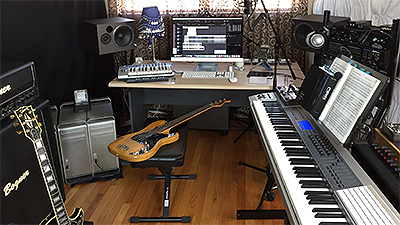
(requiring me to dive into AI by setting up
my own AI lab in my studio to do some very
deep analysis of it). Doing that meant
sacrificing all progress on updating the
site. ("The needs of the many outweigh the
needs of the few". [No, I'm not a
Trekie; just sayin'.]) This is a bit more than
simple placeholder; rather than tabs, it's
mainly just a broadly ranging flow through
what my creative output is about, so people
have a clue--a chewy clue whilst the
snazzy version is cookin'. I hope it inspires
you, at least to feel better than you felt
before you got here.
:
(April 24-25) : ...What
I hoped to give you was a nice set of
new tracks; since that's still pending, I
decided to restore a nice playlist
of pre-2020
tracks for you. Being a self-contained
artist, (i.e. doing all parts myself), I
wrote most of the lyrics and melodies,
did all of the arrangements, and
performed all vocals and played, or
MIDI-programmed most of the
instrumentation; (with the exception of
the all Elven/Quenya lyrics, and those
of the Russian song, as well as the
guitar on the Bossa Nova tracks, and the
background track to "Insensatez",
which is the one from the classic
performance of the song by Astrid
Gilberto, with Stan Getz on sax.)
The Complete Playlist
See below for
song details
AoP
(Pre-2020) Demo Playlist
(Except "Catcher Dawn",
all the below demos were produced in my home
studio.
Catcher Dawn was recorded live in Don ("DJ")
Freeman's studio, L.A.; engineered by Warren
Giancatarino. If the format
isn't specified beside the song title, it's a
full-blown arrangement.
The order of the songs
in the playlist follows the non-linear demo
number sequence.)
As a spiritual
teacher, my millieu is Tolkien-based Elven
spirituality, which is formally recognized as a
sacred tradition that's equally as
viable as all the world's major religions, under the U.S.
Federal Law Protections for Religious
Liberty. The opening track of the playlist
is my melodic interpretation of Tolkien's, "Galadriel's
Lament", from the Fellowship of
the Rings; the first book (or movie) in the
Lord of the Rings trilogy. When I
heard him recite it, I also clearly heard
parts of it melodically--which were
strikingly different from those
Gregorian-esque lines that Donald Swann
composed. So, I allowed the
full Song to come through; basing the
cadence of my melody on his recitation, to
represent the melodious nature of the way
Elven speech is described in his
Middle-earth writings.
Scene: At the end of Fellowship of the Ring,
as the Fellowship is leaving Lothlórien, Galadriel sings from
her Swan-ship:
"Ai!
laurië lantar lassi súrinen,
"Ah! like gold fall the leaves in the wind,
yéni únótimë
ve rámar aldaron!
long years numberless as the wings of trees!
Yéni ve lintë
yuldar avánier
The years have passed like swift draughts
mi oromardi
lisse-miruvóreva
of the sweet mead in lofty halls beyond the
West,
Andúnë pella,
Vardo tellumar
beneath the blue vaults of Varda
nu luini
yassen tintilar i eleni
wherein the stars tremble in the song of her
voice,
ómaryo
airetári-lírinen.
holy and queenly.
Sí man i yulma
nin enquantuva?
Who now shall refill the cup for me?
An sí Tintallë
Varda Oiolossëo
For now the Kindler, Varda, the Queen of the
Stars,
ve fanyar
máryat Elentári ortanë,
from Mount Everwhite has uplifted her hands
like clouds,
ar ilyë tier
undulávë lumbulë;
and all paths are drowned deep in shadow;
ar
sindanóriello caita mornië
and out of a grey country darkness
i falmalinnar
imbë met, ar hísië
lies on the foaming waves between us,
untúpa
Calaciryo míri oialë.
and mist covers the jewels of Calacirya for
ever.
Sí vanwa ná,
Rómello vanwa, Valimar!
Now lost, lost to those from the East is
Valimar!
Namárië! Nai
hiruvalyë Valimar.
Farewell! Maybe thou shalt find Valimar.
Nai elyë
hiruva. Namárië!"
Maybe even thou shalt find it. Farewell!"
1.
Namárië
(A Cappella)
(Language: Quenya [Elvish])
(Keith Jarrett
somewhat inspired this piece. He taught me
[and lots of other musicians] that, if
you're really know your shizzizit, you can
just walk on stage with no clue about what
you're going to do, and entirely improv your
way through a concert.) "Catcher Dawn"
was recorded on tape. The tape was rolling,
the mic was hot, and I had zero clue about
what I was going to sing until it entered my
mind. It came in movements; and I just kept
singing until it was done.
2.
Catcher Dawn
(A Cappella; Jazz Improv)
"Smile"
was Michael Jackson's favorite song. I had
just gotten out of the shower, and was
walking into my living when I heard,
"We'll be back in a moment with more about
the death of Michael Jackson!"-- ("W -
T - F?! Did I really just hear that!?")
-- After settling my emotions about the
news, I sang it to him as a swan song, at
sunset, that evening, 09.03.2009;
recording it--for the first and last time.
3.
Smile
(A Cappella; Vocalise)
"He is
There" came to me out of
the blue, one evening, as I was thinking
about my Christian greater family; i.e.
the congregation of (Bishop) Rev. Dr.
Yvette Flunder's "City
of Refuge UCC", in Oakland, CA. I
intuitively heard, "Read
the Word. Don't be scared. Trust the
Lord; He is there!" with that melody, and thought,
"OH--That's RICH!", (as in rich in
Presence), and just went into my studio
and recorded that on the fly, part by
part; allowing each part to solidly
resonate within my body before recording
it. Primarily, I'm singing to
Queer/LGBT... Christians.
20.
He Is
There
(A Cappella ~
Soprano-Alto-Tenor-Baritone)
(Language: English)
Singing jazz
vocalise/scatting is my favorite way to
sing; i.e. not being bound to intuitive
Flow-constricting words--which probably
doesn't above show, considering my
singing in 5 languages in the playlist.
I particularly enjoy singing Bossa Nova
(BN), especially Antonio Carlos Jobim's
melodies, and soloing over his chord
changes. And I'm very grateful for the
influences of Ella Fitzgerald, Flora
Purim and Kenny Rankin in my
vocalise development; and of Elis
Regina and Gal Costa in the
development of my BN
sensitivities
and sensibilities. The
next 4 songs of Jobim's were sung
live and are unedited;
they're just a record of me having fun
at home, with the mic on and open. (For
differentiation, I perform Jazz using
my first and last names.) (The MIDI
guitar tracks were coded in
Brasil; I've forgotten by whom.)
I stumbled upon a
copy of the rhythm track of the famous
version of "Insensatez"
with Stan Getz on sax. I simply sang it my
way.
:-)
When
I first heard the term, "non-binary", I thought,
"Wow, this generation is so intent on having a
self-defining, gender stereotype defying term,
they're not even aware of one that's already
stood the test of time!" To be androgyne is to
be a person who's gender balanced. As you'll
read (if you read), the term applies to all
demographics; cis, queer, and questioning. For
those questioning, this article may be a
godsend; it enables people to drop the question
and just be themselves. There is a demographic
for whom that questioning will only be lessened,
but not alleviated; the trans community.
[Tangent]
(Click the title to open the Primer)
A
Brief (Impromptu) Primer on Gender Dysphoria
What's
the difference between "transgender" and
"transsexual"? THAT is one of the most
difficult questions for trans persons to
answer themselves. Look at two words; the
difference answers the question. The
former refers to non-genital shift of your
socially-perceived gender to conform with
your inner gender self-perception. The
latter entails that too; however, it
extends to the literal structure of your
genitals as well.
Try to wrap your head around this for a
moment:
If
you're not transgender, do you
remember how your bodily self-image
matched the gender that was medically
assigned to you by virtue of your
anatomical sex at birth? Your natal
body had a penis (M), or vagina (F)
[if not born intersexed]; you grew up
thinking and feeling you're a boy [if
M], or a girl [if F], and you've been
totally cool with that forever.
Generally, gender norms in most
societies aren't set in stone; there's
a lot of variance. E.g., if you were a
girl, you enjoyed looking and behaving
the way most girls do, regardless of
whether they're "tomboys", or
"girlie-girls". If you were a boy, you
could be an hard jock-head, or a soft
sensitive type. Either way, by age 7,
your gender identity is set; it's
locked. Let's refer to that as your authentic
gender. Either way, you had no
problem when puberty hit, and your
biology took control of your dominant
sex characteristics--you were still
tomboy, girlie-girl, jock-head, or
sensitive type, as you were. You may
have been straight, or lesbian, gay,
or bisexual, however, there wasn't a
fundamental schism between your
medically-assigned gender, your
authentic gender, and your sexual
development. Getting into the nitty,
let's focus on persons born female.
Now,
imagine you're 4-6 years old and,
intellectually, your eyes see that
your body has a vagina; however, when
you close your eyes and imagine your
role in society, your self image
decidedly matches that of most boys.
You're just beginning to get a grip on
the most fundamental differences
between people at that age. You see
that your body is genitally like
girls, and for reasons you're not
going to understand, much less be able
to communicate, perhaps for another
decade, or more, your constant
self-image aligns with children who
have penises. The usually very wide
prepubescent gender variance amongst
same sex persons enables you not to be
emotionally consumed by the dichotomy
between your inner perception of your
sex, and your outer social role;
however, there's a very critical
psychological pressure cooking.
If
your genes don't hard-preset your
gender appearance, you may socially
float; you know you're a "girl", and
you also know you're He-Man, or the
winner of some kind of male
competition, or part of a winning male
sports team. Then, puberty hits and
your flat chest doesn't become a pair
of strong pecs; it becomes a pair of
squishy titties. Instead of slender
hips and developing abs, your hips
spread by 10%-40% and developing abs
just ain't hap'nin' like boys because
your body's preparing your uterus for
childbearing. [Let's not even get into
menstruation!] If you're a
female-to-male (FTM) transperson,
you're still fine with having a
vagina; but all those other factors
that decisively define social gender
are diametrically opposed to your
inner self image which you've had for
nearly [or, perhaps more than] twice
your lifespan at that time. If
you're a FTM transsexual, you have
the same kind of social role schism
regarding your gender--but, your
self body-image has a penis too--and
the biggest trip is that you also
have an imaginal*
felt sense of having a penis.
In both cases, something's gotta
change. It's the
inverse for male-to-female (MTF)
transgender and transsexual persons.
Let's go one small step, for this
conversation; huge leap for your
understanding. Men, try to imagine
feeling as though your body has a
vagina, even though it's obvious to
you that you have a penis; perhaps a
cervix-long one--based on your
heterosexual experience. Every time
you stand up peeing, your brain is
having a challenge because it's
experiencing somewhat of a
psycho-emotional schism; because it
expects you to be sitting, or at
least squatting as you're doing so.
You wipe the tip when you're done,
and your brain thinks you should be
spending a bit more time, and paying
a lot more attention to the whole
wiping process. Feeling the tension
of the schism as brain and gut
tension, you know you're going to
feel the same way even if you ARE
sitting with your body as it is; so
you pee the path of least
resistance, not even adding head
gaming yourself by sitting down, (if
sitting's not what you're normally
do anyway). That brain-gut tension
extends to when you're wearing
practically any pair of pants; your
brain not expecting to need to
adjust your 'nads to accommodate the
garment. For
the most part, when you're not
asleep, your central nervous
system is on constant alert as a
consequence of the schism; to a
greater, or lesser degree
depending on a myriad of factors.
At age 3, 4, 5, 6, 7, 8...
15, 16... 22, 23... 30...
57...--you;ve gotta accept carrying
and living with that tension 60/60/24/7/365.25; or
something's gotta change.) That's Gender Dysphoria (GD).
The
emotional
felt
sense
of
GD is akin to wearing a wet blanket
and wet quilt and wet duvet and
sopping wet heavy boots, along with a
sopping wet wool
hat everywhere, always; incessantly.
GD is a direct cause of chronic, acute
depression and anxiety; even if the
person experiencing it lives in a
totally accepting natal family and
community--depression which too
frequently leads to substance abuse,
in an effort to self-medicate away the
gravity of GD. Too many times, it
leads to suicide. When
someone lives with GD, some
kind of physical change definitely
needs to happen. Transgender
refers to outwardly changing one's
social gender presentation to match
one's authentic gender. That's
usually done by changing one's hair
style, clothing style, (which may
also entail wearing clothing that
modifying genital appearance, e.g.
wearing extra support tights to
disallow the penis from bulging, or
wearing pants with very loose
crotches--for either gender), often
also speech pitch and/or patterns,
and perhaps wearing enough makeup to
enhance one's gender-neutral
features, tilting their appearance
toward norms consistent with their
authentic gender. It doesn't usually
entail surgically changing one's
genitals. Like
being transgender, being transsexual entails
outwardly changing ones gender
presentation to match one's
authentic gender. However, being transsexual
also entails changing one's sex
characteristics too; perhaps not
necessarily one's genitalia.
Generally, that change always begins
lightly; via hormonal therapy,
male-to-female (MTF) taking
estrogen to
enable development of female breasts,
wider hips, and much less dense
muscles, or
female-to-male (FTM) taking
testosterone to enable development of
facial hair, naturally lower voices,
more slender hips, and much denser
muscles. In most GD cases, that's
enough; which solidly qualifies such
persons as transgender--even with the
secondary sex characteristics
so modified. In many such cases, (i.e.
mine), even after decades of hormonal
therapy, and changing one's gender
appearance and social [even
professional] gender role, that
gravity continues to be ceaseless.
For us, ultimately, changing one's primary
sex characteristics
via Sex Reassignment Surgery, or
Gender Affirming Surgery (SRS/GAS,
ergo having vaginoplasty [changing
penis to vagina], or phalloplasty
[construction of a penis and
permanent closure of the vagina])
is the only certainly alleviating
resolution. Medically, only the latter
transition definitively qualifies
someone as transsexual; (nevertheless,
since [according to Duck.ai] "the
average cost of sex reassignment
surgery SRS/GAS in the United States
typically ranges from $20,000 to
$300,000, depending on the specific
procedures involved", most
transsexuals are unable to have that
benefit, which doesn't effectively
disqualify them from being
transsexual, if they've
psychologically have been clinically
assessed to decidedly match that
profile).
ALL
TRANSSEXUALS ARE TRANSGENDER; but,
MOST TRANSGENDER PERSONS AREN'T
TRANSSEXUAL. That fact makes it
extra challenging for transsexuals
because it can take a long time to
be certain that one's experience of
GD does, in fact, encompass a bodily
change of sexual appearance as well,
rather than just an apparent change
of gender. AND, it's not something
to try to sort out alone. For anyone
to be totally certain usually
requires a person to undergo (a) a
year, or more of clinical therapy to
determine whether one is decidedly
living with Gender Dysphoria (GD),
and (b) to what extent that may be
operative.
[End tangent]
In
my effort to make sense of my GD
experience, I was led to Dr. Harry
Benjamin's "The Transsexual Phenomenon",
one of the first formal scientific
studies of transsexualism, (https://transreads.org/wp-content/uploads/2019/04/2019-04-07_5ca961529c262_HarryBenjamin-TheTranssexualPhenomenon1copy.pdf),
when I was 21. I experience a long series
of totally resonant "Aha!" moments--and,
there was something else happening within
me that felt beyond that certainty; a
button on which I couldn't put my finger.
Several years later, I found Dr. June
Singer's book, "Androgyny: The
Opposites Within"; a strictly empirical scientific study
of androgyny, (Anchor/DoubleDay
paperback (1976/1977) — ISBN-10:
038511026X / ISBN-13: 9780385110266);
finding it not only put my finger on that
button, it mashed it to the max!
Certainly, being born with a "M" as my
designated sex, I actually inwardly saw my
body as "F" since I was 4; however, I
wasn't uncomfortable with my masculinity,
and stereotypical femininity (i.e. the
American version) seemed too
self-limiting. I had spent a lot of my
time during the previous decade finding
ways to balance gender within, with very
remarkable success, and Dr. Singer's book
helped me to understand that part of my
Journey as a very natural human experience
that very few people allowed themselves to
experience. I don't recall her ever
mentioning "transgender", or "transsexual"
in that book; (could've, and it's been too
long for my recall to be accurate).
Finally, I understood I'm an androgyne; it
took a lot longer to clinically confirm my
GD, and my transsexuality.
A few years later, I wrote "On Being
Androgyne"; as an illumination, rather than an
autobiographical piece. The year before she
died, my mother read it. When she finished,
she looked at me and said, "Now, I finally
understand you!" I'm grateful my showing
it to her enabled her to do so! May it also
help other parents to understand the true
Nature of their androgyne kids.
If you're an androgyne, and your parents
don't get you; enable them to read it
also--
perhaps it will help them to finally
understand you too.
(By the way,
dispelling the stereotyping of MTFs as gay
men who change sex to be with men as
women, I know many MTFs, and almost all of
them lived as straight men before
transition, and only lesbian afterward.)
The
Science of Transgenderism
"It's very rare that the natural world
gives us totally clear-cut dichotomies...
The way people have traditionally thought
about trans individuals is 'This is someone
who for some reason thinks they're different
sex than what they actually are'. What the
neurobiology suggests instead is 'This is
someone who has had the incredibly crappy
luck of being handed a body that happens to
be a different sex than who they actually
are'.
I
recorded songs tracks 9-15 in the
playlist with my virtual band; TransAction.
To differentiate between my Jazz and
my Pop, I produce and perform my brand
of Pop using only my middle name;
Alyras..
.
"Something
About You" is a straight up
lesbian come-on song. For me, the joy of
the song is how is came to be. I was
working as a techie in what was San
Francisco's premiere data center, one
night, and the groove came to me as I
walking down one of its 2-block long
hallways; at that tempo. The groove just
slid into my mind, "(1) Doo-Doont (2),
Doo-(3)Doont;
(4)Doo Doo!". I sang the groove into my
phone, and coded the MIDI tracks and
fleshed out the song after I returned
home. When I hear it, I always feel that
initial--"Oooooohhhh!" that I
felt and thought when the groove just
locked-step with mine.
9.
Somethin’ About You(Language:
English)
8.
The Girl I Can’t Get To
(Voice/Piano -- both
self-performed)
(Language:
English)
"Hey, Cool!"--Waaay back, my
son, Aryeh-Or [Aryeh-Or.com]
told me I had no clue about how to
write a good Hip-Hop song. To date,
I've been songwriting longer than he's
lived. I didn't argue; I just wrote
and produced that, and let him hear it
a few days later. He promptly
apologized. [Check
him out. :-D As a thespian,
author, and musician, he's
definitely got tasty juice! ]
The
inspiration for the song was a
video clips of a shooting was
between two rival gangs in
Chicago; filmed from an high-rise
window. I'm speaking to black
Millenials and Gen Zs.
10.
Hey, Cool!(Language:
English)
11.
Give Me Your Time(Language:
English)
Back in the
day, [thanks to the help of
Richard (Dick) Rudolph, Don
Freeman and Warren Giancatarino],
John McLain wanted to sign Lenny
Kravitz and me to A&M (as the
"Black Lennon and McCartney");
while Jheryl Busby [head of Black
Music] at MCA was offering me a
solo deal with Universal. My
manager, Brian Avnet, advised me
to take the MCA deal. Thing was,
MCA was buying Motown, and as soon
as that deal was sealed, they
began dropping artists who were
more aligned with my music, (e.g
Joe Sample, Stephanie Mills,
Gladys Knight...), in favor of the
teen market, e.g. Shanice, New
Edition/Bell, Biv Devoe, etc.
(Brian and I didn't see that
coming). The month I signed,
Brian
went on a long hiatus, (for
fam reasons);
Dick
had already bailed to produce
Timothy B. Schmidt's solo
album;
Jheryl
left to lead Motown;
my
A&R person bailed to
another company; and
my
publishing lead also jumped to
another publisher.
Everyone I needed to just get
my feet squarely on the major label
ground were gone--and the first
thing I heard from the woman who'd
been given my case, the second I sat
down after going to her office to
meet her, was, "I don't like your
music!"
[
In-my-face verbal abuse,
from the jump--WTF
was I supposed to do with
that?!?]
I'd signed
the deal during an intense Mercury
Retrograde (Merc Rx) cycle; which
is how I learned about Merc Rx the
hard way! The MCA axe hit lots of
artists very hard. My
understanding is that Stephanie
put L.A. totally behind her and
went back to performing on
Broadway;--(Before moving to L.A.,
I used to sing through most of her
"Sweet Sensation" album to warm up
for gigs--if I could nail HER
chops, I could totally rule on
stage! lol). Joe suffered a major
psych dive, (what we used to call
a nervous breakdown) because of
it; Gladys went back to Gospel
music, starting a choir in Vegas.
After a year of zero traction,
increased debt, a 1 year old
[Aryeh-Or] and a sibling newly on
the way, I convinced the label to
pay out my contract and went back
to freelance.
Jump many
years ahead. Lenny's crushing it
:-D; and I'm raising my kids on a
bookstore salary. [One of the best
parts of that experience was my
personally being able to assist
Lisa Bonet when she came there to
find books to help her to bring
Zoe into the world in the
healthiest, most balanced way. I
simply led her to the great,
spot-on books I'd discovered [and
personally used very well to raise
my kids, (up to age 5)], and some
to which I'd been introduced
there--and, apparently, those
conversations bore great fruit!]
This song, "Heavenly Virtue"
is what came out when, (20ish
years thereafter), its Lenny-like
groove wafted into my mind. As
soon as I was feelin' it, I
thought, "This is the kinda groove
Lenny likes rockin'!"; so,
somewhat as a nod to him, I turned
it into a full song; maintaining
the groove the way I think he
probably would, and evolving it
the way I would.
The groove of the song emulates
what I've heard of Lenny's music;
the melody's all me. (Maybe John
was onto something?)
12.
Heavenly Virtue(Language:
English)
I'd
become bored with the Verse-Chorus-[same
melody]Verse-Chorus-Bridge-Chorus (out)
song structure. I mean rreeaally bored. So,
being a composer first, songwriter second,
(I'd written several orchestral works before
turning to songwriting), I stepped back to
see a bigger picture; initially, exploring
songwriting in other languages. Then, I
stepped back a few hundred years, and
considered what's stood the test of time in
Western music prior to the greater
popularity of songwriting. The ternary
structure, most evident in the sonata and
symphony forms, ruled before then. That
format is simple: A [introduction of melodic
theme]--B [contrasting theme, usually
slower]--A [effective repeat of the original
theme]. I decided to develop an hybrid
approach. The following 3 songs are part of
the initial shift. (Then, I decided
to follow my spiritual heart into exploring
songwriting in the Elven language, Quenya;
i.e. the one in J.R.R. Tolkien's "Lord of
the Rings", and "Silmarillion". That's what
I'm doing now.)
Representing it, I think (Portuguese) "Angie"
is the best example of that foray's adhering
to the ternary form. (Quenya) "I Calyala
Latië" [#6 in the playlist] is an
variation of the form; more consistent with
my EDM heart space.)
I met (the
Russian) poet, visual artist, etc.,
Nadia Mogilev, when we were living in
San Francisco. We decided to explore
songwriting together, starting with some
of her poems. When she explained the
significance of "Dve Rozi"
(Two Roses)--i.e. in Russia, when you're
in a romantic relationship and wanna end
it, 2 roses in a vase is the unspoken
message--I felt the depth of those
currents; hence, the song.
13.
Dve Rozi(Language:
Russian)
I had a crush on a
French woman I'd hung out with in L.A.,
who returned to Paris. Hence, the title,
which is "You in Paris and Me in L.A." in
English
14.
Toi à Paris et Moi à L.A.(Language:
French)
I wrote "Angie"
somewhat academically; (although
it was sparked by an actual,
beautiful woman named Angie, whose
voice was as soothing as
gently-swift water flowing over a
pebbled riverbed, and whose laughter
was like lyrical birdsong--a
short-time close friend who moved to
Brasil, and got lost in the
bifurcation of the waves of our
lives.) I wanted to write a
song in Portuguese, I don't speak
enough of it to save my life; however,
I had a couple great Pt. grammar books
and dictionaries, and, (thinking
of her), "Angie, esta
cancao e de voce" (Angie,
this song is for you!) was a phrase
with a grip. So, I fleshed out the
lyrics around that concept; then, I
stumbled upon an old, i.e. 1950's b/w
musical from Lisboa/Lisbon, heard and
felt their accent with an odd sense of
returning home--although I've never
been to the EU. My accent is
Continental, rather than Brasilian; as
you'll hear in this, and in the way I
sing Jobim's "Insensatez".
15.
Angie(Language:
Portuguese)
People have been using AI to create
music sung in Quenya, the Elven language
introduced by J.R.R. Tolkien, mine is
completely original, and I'm singing it.
(In fact,
I've never used AI to create music;
aside from being totally authentic,
the intuitive process is to delicious
for me to do that.) The Quenya
(Elvish) lyrics were all written by New
Zealand's late, renowned Quenya
translator, Rodger Francis Ashton-Smith.
We were discussing exploring songwriting
together, and I suggested he
translate the entire Tao Te Ching, so we
could use that body of work as lyric
source; i.e. one song for each of its
chapters. The next 2 songs, "Oiolumellë
Er", and "I Calyala
Latië"
are from that expansion. We call our
collaboration, "Ilúvamil"
(Mother of All); respecting that it was
She would enabled us to meet.
5.
Oiolumellë
Er
(Language:
Quenya)
Project: Ilúvamil
6.
I Calyala Latië
(Language:
Quenya)
Project: Ilúvamil
I composed the "Lótessë
Medicine Song" after
completing my sound healing training,
with Silvia Nakkach @ California
Institute of Integral Studies. For
Tolkien geeks, Lótessë is the month of
May, during which people who walk the
Elven Spiritual Path annually explore
personal relationship with the Valië,
Nessa.
7.
Lótessë Medicine Song – Opus 1 ::
(Honoring the Valië,
Nessa) :: Flutes & Chakapa
IMHO,
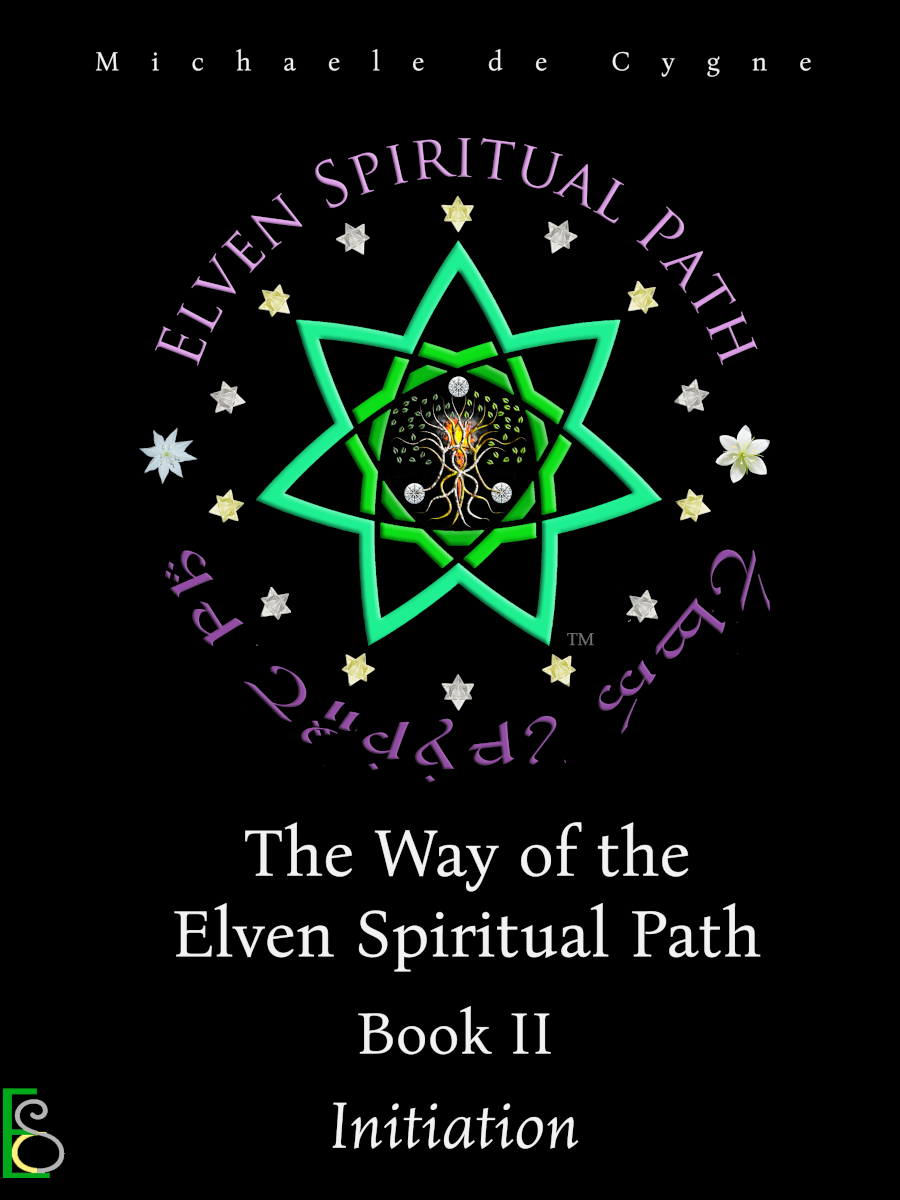
The
Way of the Elven
Spiritual Path :
Book II: Initiation
is both an excellently
exceptional, full reveal of
the Tolkien-based** Elven
Spiritual Path, for all who
are deeply drawn to it; and a
premature expression of it as
well. Frankly, it was a rush
job; written in 2 months. In
early June 2022, several
astrologers were saying an
astrological window (so to
speak) was going to open that
August, and all new spiritual
understandings, processes,
and/or belief systems that
were codified and formally
published during that window
would successfully take root,
and flourish as the Aquarian
Age now unfolds. The Silver
Elves have been writing about
their sphere of Elven
spirituality for decades;
certainly, the world deserved
to know at least a (by
comparison) tad about the
(Tolkien-based) Elven
Spiritual Path; and the Path
deserves that flourishing too.
Only 3 people were qualified
to write the book, one other
two had obligations preventing
them doing so, that they
couldn't just park for 2+
months to git 'er done. So, I
got 'er done; (First Edition
first draft, at least,
including a few
typos--nonetheless,
got 'er done, with all
fundamental parts and
particulars;
on the last day of that
window--publishing it
with Amazon and ssssliding
through the gate before
it closed.) I'll probably
release the Second Edition in
2027--along with the beginning
of a series of new books also
written to enable people to
have a lived experience of
Elven spirituality, and of
Elven timbre of Life.
The
Elven Spiritual Path is
fringe, yes; however it's not
cultish, freaky, or weird.
Like the world's major
religions, it's fundamentally
rooted and anchored in the
individual's personal
Relationship with the Divine
Feminine (DF); with a
particular added flavor.
(Interestingly, like Tolkien,
I was led to this Path via the
Relationship I began with the
DF in Christianity, albeit the
American "Metho'-Bapti'-Evangeli-Pentacostalic",
rather than the Catholic
version.)
The Legendarium reveals an
innate, spiritual
sibling-Nature humans have
with Elves. Given a conscious,
intentional, genuine
actualization of that Nature,
humans may integrate it into
their microcosms and lives,
being increasingly able to
express Elf-like personal
energy wherever we go--e.g.
generally unf***able peace,
balance, grace, holistic
harmony with all of Nature and
with all other spiritual paths
arising from and expressing
Love. The book teaches people
how to do that,
individually, on their own;
with genuine Relationship and
effect, and without
affectation, or trappings of
any kind that they can't have
with them in the middle of a
lake, wearing only their
birthday suits.
Alternate
Purchasing Option
The
501(c)(3) charitable trust, ElvenSpirit,
parents and hosts content for
the organization also named,
"Elven Spiritual Path", (which
is also such a charitable
trust). You may receive an
indie-published PDF of the
book as a Thank you! gift when
you help to advance that Path
by donating $10 to the trust
for that purpose. Click on
either below-related image to
jump to the Elven
Spiritual Pathhome
page, where you'll find
the access link.
Thank you!
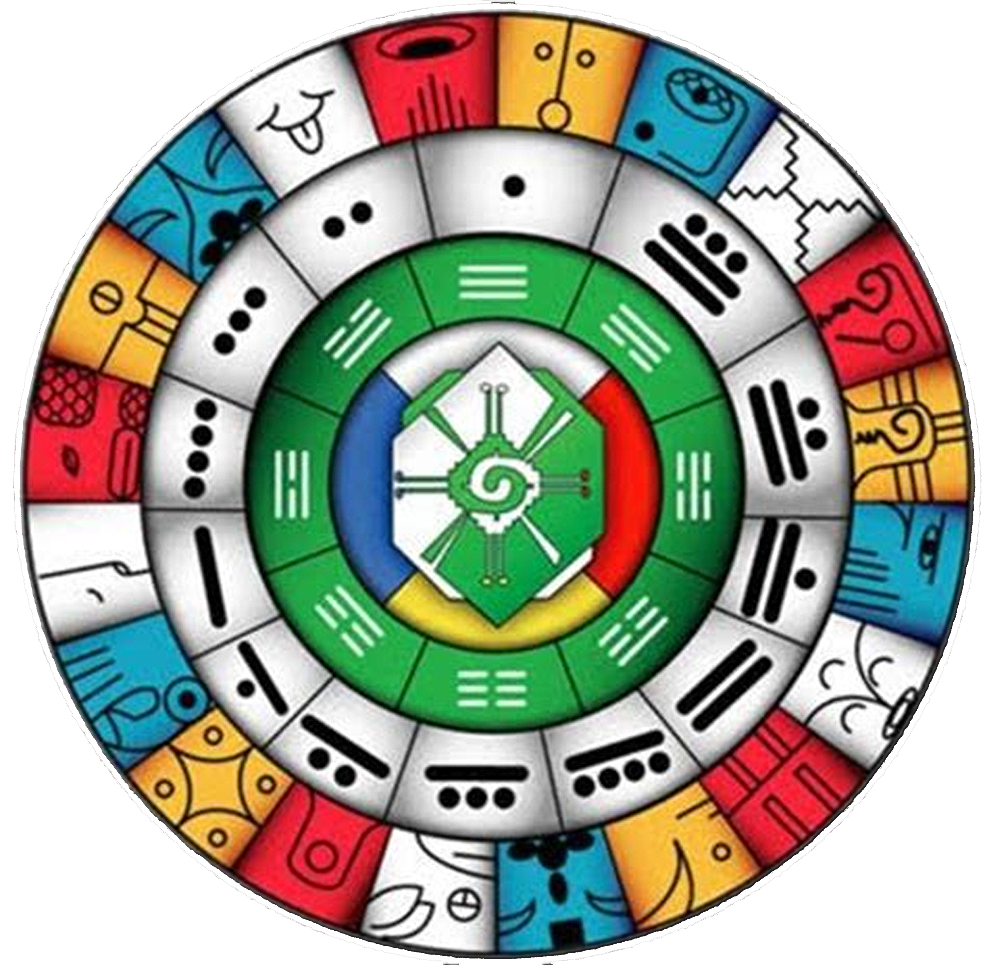
I began creating cognitive
enhancement media in 1987, when I
translated the Mayan Sacred Calendar
("Cholq'ij", or "Tzolk'in") into
sound. In the early 2000's I expanded
the audio to include video; the colors
being the tones elevated into the
light spectrum. (I call that form of
software "sonochromatic",
sound+light.) In 2018, as I was going
to release a seriously badass
expression of it, not one, but all 3
of my laptops suddenly went to
ultra-crawl, i.e. while they'd been
exporting builds within an hour,
suddenly they were taking 3 days to do
so. It was a totally commercial
project; for 2 MacBook Pros and a then
brand new PC to be doing the same
thing, apparently Hunab Ku (Source)
wasn't havin' it--things dragged to
the point where I completely missed my
launch date, which led to great loss
on my part.
So, recovering, I decided to
develop derivatives using an entirely
different fundamental structure; same
principles, different Model. The new
Model I chose was DNA. I'd come across
research showing how the 64 hexagrams
of the I Ching and the 64 codons of
DNA have direct 1:1
correspondence--which means they are
effectively 64 music chords;
specifically, quadrichords (4 tones
each). That made it mathematically
easy for me to convert the Tzolk'in's
code to conform to the new Model's.
Harmonic
Tzolk'in/Cholq'ij
SonusLumine
has 2 divisions, "BrainNeo",
(which provides "Rebound!"), and "Synaptogenesys";
the latter being more advanced
than the former insofar as it
integrates portions of both
Models. A few days ago, having
rejoined the Tzolk'in Work, mainly
to analyze it using AI, I released
a new prototype called, "Harmonic
Tzolk'in/Cholq'ij" on
YouTube.
SonusLumine's
products are all dynamic, whole brain
synchronization and cognitive
enhancement modules designed to
radically advance neuroplasticity;
particularly for persons who are
experiencing post-traumatic brain
recovery, Chronic Fatigue
Syndrome, and other neurological
conditions which are ameliorated
by doing things that involve any
form of pattern recognition-based
therapy. Rebound! is free;
as is Harmonic Tzolk'in/Cholq'ij.
Synaptogenesys is a paid
subscription service.
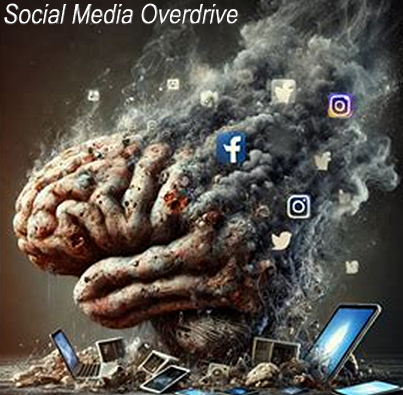
One brief comment about addiction
to social media, (and, soon, AI):
Several weeks ago, at the
University of Minnesota, I passed a group
of Gen Z young women. Soon after I passed,
one of them began exuberantly telling the
others that she was simply going to use
ChatGPT to do a critical assignment that
was imminently due. "I'm just going to go
to ChatGPT and have it whipped out in few
minutes". I thought of backstepping and
advising them not to go there, not to do
that; however, I also felt that it wasn't
my role, and went my own way.
As you've read above, I'm into AI;
however, I'm a Boomer, which gave me the
great advantage of being able to
well-develop my Natural Intelligence (NI)
before social media and AI came onto the
scene. I OWN that; and I can rock
the [bleep] out it! BILLIONS of people
younger than 30 years old cannot say that!
Why? Primarily, because they're addicted
to social media, which isn't giving their
young brains the stimulation necessary to
develop true mental acuity; true brain
power.
Me:Worldwide,
are most people under age thirty in
developed countries addicted to
social media?
Duck.ai:Yes,
a significant number of people under
age thirty in developed countries
are addicted to social media, with
approximately 40% of young adults
aged 18 to 22 reporting signs of
addiction. This trend is
particularly pronounced among
teenagers and young adults,
indicating a high vulnerability to
social media dependency.
.
This
is literally more serious than an
heart attack--
an
heart attack doesn't posit the acute
possibility of national collapse due to en
masse loss of critical thinking skills;
(for any country so mentally dependent on
social media as the United States has
become)!
You need NI to get the most out of AI; and
unless it's been dumbed down by social
media, substance abuse, or abuse from
others, NI isn't fundamentally affected by
casual use of social media, or AI.
Don't get me wrong; I'm not anti-AI. In
fact, I've gone off the deep end with AI
use; having my own AI lab, with a least 9
LLM models, so I don't need to use
ChatGPT, Claude, Mistral, or any other
online AI. During the past 19ish months,
I've used AI to write 5 books, and am
making great progress on getting a deep,
peer review-level analysis of my SonusLumine media
using it--massively intensive research for
which AI was a boon for my NI. Because I
already have both research and writing as
well-developed skills, I'm able to pore
through what AI has written for me, critically
reading through the material, and very
frequently correcting it, and
helping it to help me more effectively.
Without applying critical thinking to the
process, I would be setting myself up for
ridicule by anyone else who did so, and
challenged "my work"; with applying
critical thinking, I actually take
ownership of the work; enabling me to do
it better without using AI when AI isn't
available. If I were looking for a job,
that would very favorably set me apart
from the crowd when the interview turns
out to include 1/2 an hour to write a kick
butt 5-paragraph essay about any given
preset topic.
If you're young, and
feeling pressure to compete with your
peers who are cranking out assignments
using AI, (whether academic, or
professional), do not take their easy
route; you'll lose exponentially more
than you'll gain by doing so. Heed my
counsel; make increasing your NI
more of a priority than increasing
your use of AI, and watch where
you're at in life in 20 years--while
you're still young--compared to your
peers who are not heeding it. I assure
you, when you get to 2046, you'll be far
better at living your best life by doing
so than everyone who's thought they
could fast track themselves by not doing
so. The U.S. Navy Seals have a
fundamental working principle: "Slow is smooth,
and smooth is fast".
Applying it to how you use AI, in
contrast to your peers who don't, will
save your quality of life from being in
the pits one short generation down the
pike.
As far as social media is
concerned, I very strongly encourage you
to watch long videos requiring critical
thinking, and avoid shorts--shorts
lower your attention span, which lowers
your critical thinking ability, which
increases the stress and anxiety you'll
experience simply trying to live;
which ultimately shreds your
professional/commercial value and
competitiveness. Even better--READ actual
(old school) books; remember those?!?
Kindle being a reasonable substitute. At the very least, get
into crossword puzzles, and make a daily
practice of working some--even if it's
only one, spread across several days. You
may also freely use Rebound!
[forever] to rebound from social media
oversaturation, and super-rapidly build
yourself a more dynamically resilient
brain.
This isn't
confined to human intelligence--THIS
ALSO APPLIES TO AI!
A few days ago, I was
listening to a Tristan Harris interview
discussing AI, wherein he said that AIs
trained on brain rotting content also
acquired irreversible brain rot
themselves. Doing my own due diligence to
find confirming info and data, I didn't
need to look far; I think I used "AI brain
rot" as a search term, and immediately
found a study done by scientists
at Texas A&M University, University
of Texas at Austin, and Purdue
University, an article from Futurism
expounding on it (which I printed as a PDF,
because it has several follow-up links to
some very interesting supporting pieces
that might not be there when you directly
access it). Now, I ask you, if brain rot
is an across the board phenomenon, whether
it's with NI, or AI, wouldn't it be wise
to at least learn how to use AI in ways
that don't advance it? Wouldn't it be wise
to also learn how to use social media,
(and, in fact, the entire social
Internet), in ways that help to prevent
you from acquiring it? Yes. And
Yes.
Whether it's social media,
or AI, whatever age you may be, don't
give up your brain power. Own your
brain; own your mind; own your life.
Lose your brain; lose ownership of your
mind; lose ownership of your life.
In
this article, where AI wasn't quoted, AI wasn't
used.